Showing posts with label CoL inquiry. Show all posts

Friday, 7 December 2018

Taking responsibility for learning/success

I am so impressed by one of my "Jumpstart" learners who encountered something that she did not understand and instead of waiting for the maths period the next day, tried to figure it out for herself by accessing her CHEAT SHEET.


This is her message to me.

6 Dec 2018, 23:04
Hi Miss, 

I just want to make sure if I'm on the right track with my Conclusion in Activity 7: French/German PPDAC 1. From the site, there is one column of data that shows a question mark. So I read through the site where there was guidance for this missing data. I managed to understand what could be done to this missing data, I just want to know if I can talk about it in my conclusion as "predict" for excellence. 

Thanks. 


Her interpretation was spot on. By having a clear understanding of the requirements of the standard and the evidence needed for the various achievement levels, she was able to make headway despite coming across what could have been seen as a stumbling block.


Wednesday, 21 November 2018

Student Voice

3 of my NCEA L1 learners sat their maths external exam yesterday. 
One of them gave me verbal feedback saying that only question 
about median confused them but they chose the middle value.  

The other sent me an email

Afternoon Mrs! The exam was good! It wasn't too hard as I 
had already knew what to write for each question because 
of your study notes and help!  It was like doing a normal assessment in class! 
Thank you Mrs for your help and guidance! :)


Tuesday, 4 September 2018

Sharing best practice

My Inquiry in under 60 seconds was shared with teachers in my department today and they were encouraged to share best practice/their inquiry so that pockets of excellence can be spread throughout the department. I look forward to being inspired by their videos.

Monday, 27 August 2018

Snapshot of how I am raising Maori achievement in NCEA L1 maths

 This is the second year that my inquiry is focusing on raising Maori achievement in NCEAL1 mathematics.

I am continuing to:
- teach in context so that learners see the relevance of the learning
- use literacy strategies to give learners more confidence in the subject
- focus on the key competency "managing self" so that learners take ownership of their learning.

This year I have made a concerted effort to promote:
- "language in abundance" which supports NCEA achievement as all learner evidence needs to be explained in context.
- the inclusion of teacher-created teaching and learning strategies to give learners a head start in understanding mathematical content

Cheat Sheet
Chunking literacy Strategy

Student work in one place for easy access for both learner and teacher


Tracking sheet to encourage the key competency "managing self"

Challenge oucome


First thing this morning, just before 8am, I kept my word and rang home to have a chat with one of my Maori learner's parents.

I started by congratulating him on his daughter's success the previous term; 2 MERIT grades totalling 7 credits and asked if he had received my postcards sharing her success. Sadly, he did not recall receiving any mail, so I promised to resend them.

I reached out to him saying that I needed his support ...........wait for it..............wait for it............
"I need "child's name" to be present in maths every day so that she can end the year strongly. Are you able to encourage "child's name" to come to maths every day, please?" Dad did not commit to attendance but thanked me for my call.

As I am marking the roll for period 1 today, the student is being marked as absent.....

Friday, 15 June 2018

How strategies build learner confidence

The table below is our cheat sheet for our 4 credit Number Achievement Standard

Number - Internal  4 credits - Numeracy
Fraction, Decimal, Percent, Integers, Ratio, Rounding (in context)
ACHIEVED
any 3
MERIT
Answer the question
EXCELLENCE
Provide reasonable alternative answers
Literacy Strategy:
Chunking
Teaching Strategy
Association or Linking:
Look for the Fraction, Decimal Percent or Integer,
link it to a number and a key word(s).
For ratio, find the relationship between numbers.
New Tops and Old Bottoms

Set your work out as follows:

     Statement
(what are you finding)
 Working
(+, -, x, )
          Answer
(solution with units)


Below is a snippet of a practice assessment task for learners who have covered sufficient work in their Number programme in readiness for the summative task worth 4 credits.


.......... Huia earns $850 each week. Mike earns $790 each week.
Huia is able to save two fifths of her income and Mike 35% of his income.
.
  • The three-week bus trip costs 2000 Great Britain pounds per person.
  • Great Britain pounds are used as currency in England.
  • The Exchange rate is: 1 NZ Dollar = 0.5091 GB Pound ..........................


LITERACY STRATEGY
Chunking (break info into bite-sized pieces)
TEACHING STRATEGY
Association or Linking
(link Fraction, Decimal
or Percent to a word(s)
and to another number
Huia earns $850   Huia saves ⅖

Mike earns $790   Mike saves 35%

  • 1 NZ Dollar = 0.5091 GB Pound
Bus trip 2 000 Pounds
Huia saves  ⅖ of $850

Mike saves 35% of $790

Ratio :  New Tops   Old Bottoms
NZ           : Pounds
 1           : 0.5091 (Old)       
               : 2 000 (New)
1 x New   
Old                      


        Statement
(what are you finding)
     Working
(+     - x       /)
     Answer (with units)
(solution with units)
Huia saves
⅖ x $850
$340
Mike saves
35% x $790
$276.50
Bus trip
1 x 2 000
 0.509
$3 928.50

Friday, 8 June 2018

Where there's a will, there's a way

One of my Maori learners missed both assessment deadlines in term 1 worth a total of 6 credits. Our goal for term 2 was to complete the current standard before the deadline so that we could catch up on opportunities that were missed earlier in the year. In order to reach that goal, the learner realised that attending school on a regular basis was the way to go. A student voice survey revealed that she wanted whanau support in the form of making sure she comes to school every day.

 I noticed that attendance at school improved slightly and on a particular day, the learner arrived at school at 1.20pm, just in time for maths. The end result was that the learner attempted and completed all her work with much confidence and achieved her goal of 4 MERIT credits.

She immediately reviewed content and expectations for her missed assessment from term 1 and a week later she felt confident enough to sit the assessment that she had missed earlier; she gained 3 MERIT credits. Within the space of a week, she successfully gained 7 credits all at MERIT level ......where there's a will, there's a way..............

Tuesday, 15 May 2018

Clear message vs Mixed message

I have struggled immensely for the past week to write something positive about teaching and learning in my NCEA L1 maths class, so instead of highlighting all the poor choices that our learners have been making which is preventing them from achieving to their potential, I decided to pause......................

I noticed two weeks into a five-week standard, that there was an unusual tiredness and lethargy amongst some learners, so I decided to make a call to skip a few activities which were part of the gathering evidence part of the programme and go straight into revision test-type activities.

We revisited a template to help learners channel their evidence and completed one activity collaboratively. We then broke up the standard into key parts and I had a stopwatch timing their efforts for each part. At times we deleted evidence and rewrote it keeping in mind the keywords that needed to be used for success in the standard.

That created a buzz of excitement and a renewed zest for learning which was evident in the quality and quantity of evidence being shown and I now have learners making remarkable progress. A few have indicated to me that by week 3 they will be confident enough to sit their assessment and one student gave me permission to keep his cell phone for the double period so that he could focus on his learning with minimal distraction.

I hope that I have sent a clear message that success comes from hard work and not a mixed message that we can skip learning activities when learners show a lack of interest.

Friday, 4 May 2018

Success breeds success

After my students observed what successful learners do and say in a mathematics classroom, I observed a marked level of commitment and focus from almost all learners.
Successful learners knew that they were being observed, so they stepped up their commitment and focus which encouraged others to emulate. The bar had now been raised.

At the end of the school day, I sent thank you e-mails to a few individuals who had made a concerted effort to minimise their sometimes disruptive/disengaged behaviour for more successful ones.

Wish us well in our quest for success in maths.

Monday, 30 April 2018

What happens when a relevant context backfires

Today we took an imaginary walk to Mc Donalds near our school. We discussed the surroundings: petrol station, fruit and vege shop, post shop, train station etc. We visualised driving from the Mc Donalds carpark to the train station park and ride during peak hour traffic. You might ask what this has to do with maths? Well I was hoping for learners to mention that drivers would have to cross as far as the median strip (safe zone in the middle of the road) and then use that information to explain the meaning of the statistical term "median" which is the middle value when numerical data is placed in either ascending or descending order.

It eventually dawned on me that year 11's are too young to hold a driver's licence so they might not be familiar with the term median being the painted lines in the middle of the road and as passengers in cars or on buses, they are more passive and possibly not as alert as licenced drivers. My context totally backfired....... I was forced to move onto plan B as my original plan seemed foreign/unknown.

I asked each learner how many hours they spent on social media a day and we recorded our data on mini whiteboards. Good comeback with this context so I felt somewhat revived. Next step was to rearrange data in ascending order, that went well...............now onto median...............Learners were asked to highlight the middle value from their set of numbers. After about 30 minutes we all had an accurate median......phew.......it was well worth investing in that activity as every single learner can now articulate the statistical term "median"

Monday, 26 March 2018

Teaching and learning with Mrs Dunn


Teaching and learning  was done through a
teacher-created cheat sheet
which included:
Achievement criteria
Literacy strategies
Teaching/learning strategies

“Chunking” literacy strategy
(break up the context into bite-sized pieces)
was used extensively
All evidence of learning was done on a
google sheet, so that learner evidence and
feedback was in one place
A tracking sheet was used to help with the
Key Competency, “managing self” to make learners
accountable for their own learning journey/success.
Learning was done independently, collaboratively
or through conferencing

Friday, 23 March 2018

Developing teacher knowledge and cheats to improve instruction

For our linear algebra standard, I had to
-have a clear understanding of content requirements for the standard

-understand achievement criteria by accessing standard clarifications
via the New Zealand Qualifications Authority (NZQA) site

-make Algebra exemplars accessible to learners via my teaching site

-join online communities/teacher organisations to gain further
professional development


Whilst planning I had to consider culturally responsive practices to
support the achievement of all students by providing effective teaching
and learning in a culturally supported, learner-centred context.
This was done by chunking achievement criteria (Achieved, Merit, Excellence)
so that learners knew what evidence was needed to support their learning/success.
All teaching/learning was done in context to support “language in abundance”
and learner responses/explanations had to include the context. The detailed
learning programme for the standard was available via the
teacher’s Google calendar/Google site from day 1, so that learners could
access their learning at any time and work at a pace that was pertinent to them.
A tracking sheet was used to help with the Key Competency, “managing self”
as learners were accountable for their own learning journey/success.
For learners to comprehend the systems/strategies that I had created,
I had to be very explicit about the purpose and desired outcome for each
of them and this was reinforced almost daily until learners trusted my intentions.


A few of our contexts included comparing costs of:
Pizza prices - Learners were familiar with the context as we have a few pizza parlours in our community. Cost per pizza had to be explained.

Taxi fares - all were familiar with paying per km, but flagfall was a new word for most learners

Airline baggage costs - all seemed familiar with this context

Landscape costs - a consultation fee was foreign to all


Effective teaching and learning  was done through a teacher-created
cheat sheet where learners were guided how to form and solve equations
and the introduction of a few literacy strategies like

-“chunking” (break up the context into bite-sized pieces)

-“word definition” (per, flagfall, consultation fee, flat rate)

-“3 level guide” (read on the line as evidence of substitution - Achieved,
read between the lines as evidence of explaining/interpreting for Merit and
read beyond the line as evidence of creating and solving new equations
as evidence for Excellence.


Teaching/learning strategies included
-Looking for secret words like: each, every, one, single per
to identify the variable and form equations

-Using the =SUM(.....) formula to solve equations

-Colour coding cheaper options to build confidence and then explaining in context


Tracking progress/achievement

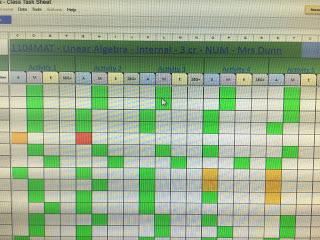
The college’s ViTaL tracking sheet was used where learners were given a green square for work completion for each activity and orange for incomplete. This system not only encourages self-management but to also prompts learning conversations about specific needs which are often easily addressed/resolved as learners can articulate their needs.

Friday, 16 March 2018

Fingers dancing on the keyboard

Goal setting, time management and learning strategies have been shown to lead to success for learners with diverse learning needs (Zimmerman, 2002).

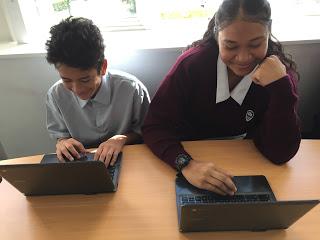
My learners are using this approach as each one has set an achievement goal (achieved, merit or excellence) for our current standard and they have a series of activities to work through in order to build up their confidence and show evidence of their learning/understanding. We use the college's ViTaL tracking sheet where learners can see how well they are progressing on a daily basis.

Some learners are tracking extremely well and working ahead of our scheduled time-frame while others have not quite met the expectation to self-manage effectively. A recent instruction to my learners has been, "I need to see your fingers dancing on the keyboard" as a way to minimise distractions and get them back on task. One of my priority learners suggested I hold onto his cell phone till the end of the period as it was difficult to have dancing fingers on the keyboard as well as texting on his phone. He managed to put in a huge effort that day. Will keep you posted as to how our dancing fingers are helping raise achievement in maths.

Friday, 9 March 2018

Building self confidence in maths

This is how learners are using Literacy and Teaching Strategies to gain confidence
with NCEA L1 Linear Algebra.
Step 1 - Understand the criteria for achievement


ACHIEVED
Form equations
Solve equations (line graph) Substitute
MERIT
Interpret data(in context)
EXCELLENCE
Create and solve your own equation
Literacy Strategy:
Teaching Strategy
Chunking
3 Level Guide
Achieved - Read on the line
Merit - Read between the lines
Excellence - Read beyond the lines
Forming equations:
Look for secret words:
each, every, single, one, per;
that number gets the letter


Solving equations:
=sum(


Interpreting data:
Colour code cheapest prices
and explain in context


Step 2 - Read the contextual question
Dominoes is selling pizzas for $8 each and delivery costs are $5. Their competitor,
Pizza Hut has a $3 delivery charge and each pizza is sold for $10.50.


Step 3 - Use a Literacy Strategy
Chunking: Dominoes has 2 numbers linked to it,  $8 and $5
                Pizza Hut has 2 numbers linked to it,  $3 and $10.50


Step 4 - Use a Teaching Strategy
Look for secret words in the contextual task; that number gets the letter
Dominoes,  $8 each, so 8 gets the letter and 5 does not
Pizza Hut, each pizza  $10.50, so 10.50 gets the letter and 3 does not


Step 5 - Form an equation based on Step 4 Teaching Strategy
Dominoes: Cost = 8p + 5


Pizza Hut: Cost = 10.50p + 3