Showing posts with label literacy strategy. Show all posts

Monday, 10 March 2025

I am having more success by doing less and I love it

 In 2024, NZQA introduced new standards for NCEA L1 and maths was hit hard as 13 achievement standards worth over 40 credits in total were reduced to 4 worth a total of 20 credits. The workload was unmanageable for most learners as they struggled with both the quantity and quanlity of evidence needed to meet the standard.


I created CHEAT sheets for each standard with:

*achievement criteria in "student speak" so that learners could interpret and understand the standard 

*research-based literacy strategies to equip learners with the necessary skills for the standard

*learning strategies to assist them with learning and understanding  


The programme for each standard had a selection of:

*rewindable learning resources

*apps to draw graphs and/or do calculations

*online quizzes with immediate feedback

*exemplars 

In the first term of 2024, only 2 learners were able to complete the 5 NUMERACY credit standard, so I reviewed and redesigned the course slightly in the second term and had a similar result which was quite alarming. 

What I noticed was that I had to sometimes go as far back as curriculum level 3 to help fill the gaps so that learners could work their way with more confidence to work at curriculum level 6. That was my mistake as my programme was too long and learners were giving up before completing the course.


When the revised progamme did not have the desired effect, I shifted my focus from "what can I do" to "what can my learners do" and that made all the difference. At the end of 2024, I set a goal for myself to turn students into curious learners, where they would check online for resources (either videos or images) to complement already-existing resources and take more responsibility for their learning, as opposed to being so reliant on me.

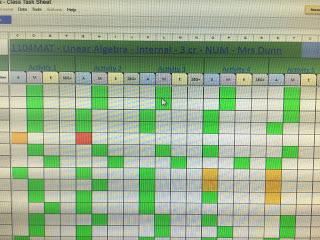
Below is a visual of student engagement using a tracking system.


                         2024 after 10 weeks                                           2025 after 5 weekes


standard met (move on to the next activity)

standard not met (work is incomplete or needs some editing)

 no evidence of learning 

standard met due to prior knowledge


My learners are engaging more with their learning by taking more responsibility. I am having more success by doing less and I love it    

Wednesday, 22 May 2024

Tuakana-Teina at its best

 Last year while we were doing introductions, one of my learners mentioned, among other things that she HATED maths and then apologised as she thought that she had hurt my feelings. I quickly cleared that up by thanking her for her honesty and telling her that my job was not to make her LOVE maths; instead I just needed her to try.

I provided her with teacher-created CHEAT Sheets as well as short videos with teaching and learning strategies for each standard and also taught her thinking strategies. The latter would help in all classes and even at home/work. She ended up being a top achiever in MATHS and now claims that MATHS is one of her favourite subjects.

I bumped into her today and she mentioned that her year 5 sibling (aged 10) was struggling with maths homework and no one at home was able to help, not even her parents. She remembered the thinking strategies that I had taught her and she used them and what do you know.................it worked. Tuakana-Teina at its best.


Friday, 7 June 2019

Working smarter not harder.............

In my 12MAT class, I have learners working on up to 4 different achievement standards at any given time and all are at varying levels of competence. In order to maximise engagement and give students more ownership of their learning, all the teaching and learning resources have been centralised on a Google site with teacher-created "Cheat Sheets", learning programmes, tracking sheets, exemplars, practice tests and rewindable learning opportunities which they can access 24/7.


In a bid to work smarter not harder, I have armed students with the tools for success thereby giving me an opportunity to conference with small groups or work one-on-one as opposed to drip feeding information to students and hampering their progress.

Monday, 27 August 2018

Snapshot of how I am raising Maori achievement in NCEA L1 maths

 This is the second year that my inquiry is focusing on raising Maori achievement in NCEAL1 mathematics.

I am continuing to:
- teach in context so that learners see the relevance of the learning
- use literacy strategies to give learners more confidence in the subject
- focus on the key competency "managing self" so that learners take ownership of their learning.

This year I have made a concerted effort to promote:
- "language in abundance" which supports NCEA achievement as all learner evidence needs to be explained in context.
- the inclusion of teacher-created teaching and learning strategies to give learners a head start in understanding mathematical content

Cheat Sheet
Chunking literacy Strategy

Student work in one place for easy access for both learner and teacher


Tracking sheet to encourage the key competency "managing self"

Friday, 15 June 2018

How strategies build learner confidence

The table below is our cheat sheet for our 4 credit Number Achievement Standard

Number - Internal  4 credits - Numeracy
Fraction, Decimal, Percent, Integers, Ratio, Rounding (in context)
ACHIEVED
any 3
MERIT
Answer the question
EXCELLENCE
Provide reasonable alternative answers
Literacy Strategy:
Chunking
Teaching Strategy
Association or Linking:
Look for the Fraction, Decimal Percent or Integer,
link it to a number and a key word(s).
For ratio, find the relationship between numbers.
New Tops and Old Bottoms

Set your work out as follows:

     Statement
(what are you finding)
 Working
(+, -, x, )
          Answer
(solution with units)


Below is a snippet of a practice assessment task for learners who have covered sufficient work in their Number programme in readiness for the summative task worth 4 credits.


.......... Huia earns $850 each week. Mike earns $790 each week.
Huia is able to save two fifths of her income and Mike 35% of his income.
.
  • The three-week bus trip costs 2000 Great Britain pounds per person.
  • Great Britain pounds are used as currency in England.
  • The Exchange rate is: 1 NZ Dollar = 0.5091 GB Pound ..........................


LITERACY STRATEGY
Chunking (break info into bite-sized pieces)
TEACHING STRATEGY
Association or Linking
(link Fraction, Decimal
or Percent to a word(s)
and to another number
Huia earns $850   Huia saves ⅖

Mike earns $790   Mike saves 35%

  • 1 NZ Dollar = 0.5091 GB Pound
Bus trip 2 000 Pounds
Huia saves  ⅖ of $850

Mike saves 35% of $790

Ratio :  New Tops   Old Bottoms
NZ           : Pounds
 1           : 0.5091 (Old)       
               : 2 000 (New)
1 x New   
Old                      


        Statement
(what are you finding)
     Working
(+     - x       /)
     Answer (with units)
(solution with units)
Huia saves
⅖ x $850
$340
Mike saves
35% x $790
$276.50
Bus trip
1 x 2 000
 0.509
$3 928.50

Tuesday, 27 March 2018

Student Voice

Student Voice
I felt super confident with Algebra because we had a programme
to work through and Mrs Dunn gave us Literacy strategies, like reading
on the line for Achieved and reading between the lines for Merit.
We also learned to use =sum(...) to solve equations.
All that helped me get a merit grade, my first merit in year 11.

I felt confident using the programme, literacy strategies and tracking sheet.

I learnt how to read between the lines to help me get Merit

Monday, 26 March 2018

Teaching and learning with Mrs Dunn


Teaching and learning  was done through a
teacher-created cheat sheet
which included:
Achievement criteria
Literacy strategies
Teaching/learning strategies

“Chunking” literacy strategy
(break up the context into bite-sized pieces)
was used extensively
All evidence of learning was done on a
google sheet, so that learner evidence and
feedback was in one place
A tracking sheet was used to help with the
Key Competency, “managing self” to make learners
accountable for their own learning journey/success.
Learning was done independently, collaboratively
or through conferencing

Friday, 23 March 2018

Developing teacher knowledge and cheats to improve instruction

For our linear algebra standard, I had to
-have a clear understanding of content requirements for the standard

-understand achievement criteria by accessing standard clarifications
via the New Zealand Qualifications Authority (NZQA) site

-make Algebra exemplars accessible to learners via my teaching site

-join online communities/teacher organisations to gain further
professional development


Whilst planning I had to consider culturally responsive practices to
support the achievement of all students by providing effective teaching
and learning in a culturally supported, learner-centred context.
This was done by chunking achievement criteria (Achieved, Merit, Excellence)
so that learners knew what evidence was needed to support their learning/success.
All teaching/learning was done in context to support “language in abundance”
and learner responses/explanations had to include the context. The detailed
learning programme for the standard was available via the
teacher’s Google calendar/Google site from day 1, so that learners could
access their learning at any time and work at a pace that was pertinent to them.
A tracking sheet was used to help with the Key Competency, “managing self”
as learners were accountable for their own learning journey/success.
For learners to comprehend the systems/strategies that I had created,
I had to be very explicit about the purpose and desired outcome for each
of them and this was reinforced almost daily until learners trusted my intentions.


A few of our contexts included comparing costs of:
Pizza prices - Learners were familiar with the context as we have a few pizza parlours in our community. Cost per pizza had to be explained.

Taxi fares - all were familiar with paying per km, but flagfall was a new word for most learners

Airline baggage costs - all seemed familiar with this context

Landscape costs - a consultation fee was foreign to all


Effective teaching and learning  was done through a teacher-created
cheat sheet where learners were guided how to form and solve equations
and the introduction of a few literacy strategies like

-“chunking” (break up the context into bite-sized pieces)

-“word definition” (per, flagfall, consultation fee, flat rate)

-“3 level guide” (read on the line as evidence of substitution - Achieved,
read between the lines as evidence of explaining/interpreting for Merit and
read beyond the line as evidence of creating and solving new equations
as evidence for Excellence.


Teaching/learning strategies included
-Looking for secret words like: each, every, one, single per
to identify the variable and form equations

-Using the =SUM(.....) formula to solve equations

-Colour coding cheaper options to build confidence and then explaining in context


Tracking progress/achievement

The college’s ViTaL tracking sheet was used where learners were given a green square for work completion for each activity and orange for incomplete. This system not only encourages self-management but to also prompts learning conversations about specific needs which are often easily addressed/resolved as learners can articulate their needs.

Friday, 16 March 2018

Fingers dancing on the keyboard

Goal setting, time management and learning strategies have been shown to lead to success for learners with diverse learning needs (Zimmerman, 2002).

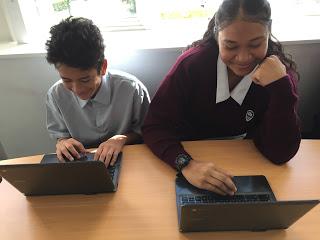
My learners are using this approach as each one has set an achievement goal (achieved, merit or excellence) for our current standard and they have a series of activities to work through in order to build up their confidence and show evidence of their learning/understanding. We use the college's ViTaL tracking sheet where learners can see how well they are progressing on a daily basis.

Some learners are tracking extremely well and working ahead of our scheduled time-frame while others have not quite met the expectation to self-manage effectively. A recent instruction to my learners has been, "I need to see your fingers dancing on the keyboard" as a way to minimise distractions and get them back on task. One of my priority learners suggested I hold onto his cell phone till the end of the period as it was difficult to have dancing fingers on the keyboard as well as texting on his phone. He managed to put in a huge effort that day. Will keep you posted as to how our dancing fingers are helping raise achievement in maths.

Friday, 9 March 2018

Building self confidence in maths

This is how learners are using Literacy and Teaching Strategies to gain confidence
with NCEA L1 Linear Algebra.
Step 1 - Understand the criteria for achievement


ACHIEVED
Form equations
Solve equations (line graph) Substitute
MERIT
Interpret data(in context)
EXCELLENCE
Create and solve your own equation
Literacy Strategy:
Teaching Strategy
Chunking
3 Level Guide
Achieved - Read on the line
Merit - Read between the lines
Excellence - Read beyond the lines
Forming equations:
Look for secret words:
each, every, single, one, per;
that number gets the letter


Solving equations:
=sum(


Interpreting data:
Colour code cheapest prices
and explain in context


Step 2 - Read the contextual question
Dominoes is selling pizzas for $8 each and delivery costs are $5. Their competitor,
Pizza Hut has a $3 delivery charge and each pizza is sold for $10.50.


Step 3 - Use a Literacy Strategy
Chunking: Dominoes has 2 numbers linked to it,  $8 and $5
                Pizza Hut has 2 numbers linked to it,  $3 and $10.50


Step 4 - Use a Teaching Strategy
Look for secret words in the contextual task; that number gets the letter
Dominoes,  $8 each, so 8 gets the letter and 5 does not
Pizza Hut, each pizza  $10.50, so 10.50 gets the letter and 3 does not


Step 5 - Form an equation based on Step 4 Teaching Strategy
Dominoes: Cost = 8p + 5


Pizza Hut: Cost = 10.50p + 3