Showing posts with label junior maths. Show all posts

Wednesday, 20 June 2018

Junior Exams


Our Year 9's did their very first high school exam on Tuesday, 19 June starting with mathematics.

I tried to create a rich task with a meaningful context covering the Number, Measurement and Probability strands of the NZ curriculum so that learners would actively engage with the context and also to set them up for contextual learning when they reach the senior school and do NCEA exams as we have moved away from teaching skills in isolation. Not only did learners have to show detailed evidence as to how they solved questions but they also had to search online to complement already-existing content; that encouraged active interaction with the task.


Image result for nz breakers logo carls jr.png adams.jpeg

Our context was about Steven Adams gifting them 4 tickets to the NZ Breakers basketball game at Spark Arena. Measurement skills included
checking online for train times and fares
converting scale diagram measurements of the basketball court
finding perimeter and area of parts of the basketball court
finding costs of the train fare if discounts were given on the day (a good way to integrate between maths strands as this was evidence of Number)

Carls Junior and Sky City Hotel are sponsors of the NZ Breakers basketball team so we used the former context for our Probability strand where learners had to look online for menus and then find the probability of certain Carls Junior combinations and the latter context was used for the Number strand. Learners had to check online for hotel and dinner prices for them, a friend and 2 adults and then work out the total cost of the prize that they had won in NZ dollars. We incorporated ratio by having them convert the total cost from NZ dollars into US dollars as Steven Adams is based in the States and is paid in that currency.

I noticed these comment from 2 of my learner's exam papers....

Thank you Mrs Dunn for creating this awesome Exam paper for us!! it was really fun. Sorry if i got some questions wrong . :)

This test was difficult, I now know what to focus on and will try harder next time

I used the HIGHLIGHT feature on teacher dashboard to see if learners were on task and the DRAFTBACK feature from the chrome webstore to see how long learners were engaged during the 2-hour exam slot and the context certainly kept learners engaged.

Thursday, 15 February 2018

Differentiation and Managing Self in junior maths


While giving learners feedback on a contextual Number task, I noticed that they were struggling with fractions when denominators were different. After using an online resource, a few learners were given an opportunity to conference/collaborate in order to build up their confidence with this L4 learning while others who understood the video moved onto another activity.

For the first time in ages, all students were super-confident with L3 (adding fractions when denominators are the same). For those who needed more confidence with adding Fractions with different denominators (L4) we came up with a strategy


Level 4 strategy (adding fractions with different denominators)
1/4 + 2/5
look at your 2 denominators - by this stage, all learners had used the "Word definition" literacy strategy to familarise themselves with these subject-specific terms)
the 2 denominators were  (4 and 5)
count in 4's (4, 8, 12, 16, 20)
count in 5's (5, 10, 15, 20)
which number is lowest and common to both (20)
that becomes your new denominator

Learners had to figure out their new numerators in order to solve.
(multiply the first numerator by 5 and second numerator by 4) to get
5/20 + 8/20
13/20

All 4 Key Competencies (KC's) from the NZ curriculum:
Thinking
Relating to others
Using Language, symbols and text
Managing self
Participating and contributing
were incorporated into the lesson.

We also trialled the multiplication method where you cross multiply but almost all learners chose the method explained above as it automatically gave a simplified fraction as the final answer.

With this new-found confidence, learners revisited the contextual task, used the "Chunking" literacy strategy where they had to break up the context into "bite-sized" or smaller pieces were pleased with their ability to solve the problem.


Thursday, 19 October 2017

Literacy in maths

To sell the importance of literacy in maths, my students and I took a mock trip to China.

Once we landed in China, we discussed taking a shuttle or taxi to our hotel and realised that none of us could speak or read Chinese. This led to a healthy discussion about the importance of knowing the language, so getting learners to define terms like:
Transformations
Complementary angles
Supplementary angles
Invariant points
Types of angles
Polygons
Bearings, to name a few, had learners attempting to understand the language of Geometry with renewed vigour. To reinforce learning, learners explained the meaning of Geometry words and then copied and pasted an appropriate image. Their final challenge was to explain at least one of the words to their neighbour and vice versa.

Tuesday, 26 September 2017

Straight line

Image result for y = mx+c
Our Junior students are learning about straight equations so after using a few online interactive resources,  playing kahoot and completing a teacher-created Quizizz resource a few were still struggling to identify the gradient, also known as the slope or m value and the Y intercept or c value.

I had a conference lesson with 3 students and tried to break it down
s........l.....o.....w..........l.......y. using this example

y = 2x - 3
Teacher: Read this straight line equation
Student: y equals 2x minus 3

Teacher: Repeat it to your friend
Student: y equals 2x minus 3

Teacher: So to find the gradient you must look to see what is in front of the letter x. So what do you see in front of the letter x
Student: (silent)

Teacher: Remember to look  to see what is in front of the letter x
Student: Which way is the front?

This was a teachable moment .........................


Thursday, 9 February 2017

Lesson Sequence


Number
Fractions: addition and subtraction

Year 9
Teacher practice
Constructivist
Experiential
Differentiation
Teacher conferenced with various groups using student knowledge as a guide and answered all questions by probing and encouraging learners to communicate their thinking collaboratively so that they can do critical thinking and show creativity as they learn (4 C’s for today’s Learners)
Learning Outcomes
Level 3: Use a range of additive and simple multiplicative strategies on fractions

Level 4: Understand equivalent fractions and addition and subtraction of fractions
Success criteria
Learners are successful if they can do basic addition and subtraction with fractions and simplify where necessary

SOLO Taxonomy
Pre structural
Uni
structural
Multi
structural
Relational
Extended abstract
I need help
I can Identify
numerators and denominators
I can describe a procedure and do calculations with Number problems in context
I can explain and
organise my thinking to solve Number problems in
context
I can create and predict solutions and reflect on
my answers
Do Now (Introduction)
Write down 4 numbers, each with 1 decimal place.
0.1   0.4   0.3   0.6

Add the first two decimals together
0.1 + 0.4    = 0.5

Now add the last two decimals together
0.3 + 0.6     = 0.9

Write down 2 numbers with 2 decimal places. The bigger decimal should be written first. Now subtract them.

0.42 - 0.30   = 0.12

Read all three answers to your neighbour (this is to reinforce a previous lesson on place value with decimals)

Write each of your Decimals above as Fractions and solve
1/10 + 4/10  = 5/10
3/10 + 6/10   = 9/10

42/100 - 30/100   121/00

What did you notice?
0.5 is the same as 5/10: we added the numerators, but kept the denominators the same
0.9 is the same as 9/10:  we added the numerators, but kept the denominators the same
0.12 is the same as 12/100 : we subtracted the numerators, but kept the denominators the same

Can we make a general rule when adding or subtracting fractions?
When fractions have the same denominator, we do 2 things: Firstly we add or subtract the numerators and secondly, we keep the denominator the same (level 3)

So what do you think happens when the denominators are DIFFERENT?
Do you think we could change the rules and add the denominators?
Learners explore addition of fractions when denominators are not the same
Teacher’s example can be used if learners need assistance and cannot self manage

1/3   +    2/6

Learners can use these  resource 1  and resource 2 to help them understand equivalent fractions

Contextual Class challenge
Tau eats ⅕ of a whole fish and Tia eats two thirds. How much of the fish is left?
Teacher provocation
Pick out the WHITE hat (important information) - Tau eats ⅕ and Tia eats ⅔
So what do we need to find if we use this information? How much fish was eaten
What mathematical knowledge do we need in order to solve this? Addition of fractions when denominators are different.
What do we need to do to solve the contextual challenge? Find out how much fish was left
How do we do that? Subtract
What word in the challenge gives you a hint to subtract? The word left
Lesson sequence
Adding and subtracting basic Decimals (up to 2 decimal places)

Rewriting those Decimals as Fractions and solving

Comparing decimal answers with fraction answers

Exploring equivalent fractions

Inquiring into learning using online resources

Making learning visible by creating personalised notes by inserting images and explaining them and documenting evidence of learners’ understanding of basic addition and subtraction of fractions
Learning Experiences
Relating fractions to decimals
Exploring equivalent fractions
Developing and using strategies for adding and subtracting fractions
Resources
Google document
Teacher’s Google Number  site
Literacy strategy
Word definition: Learners define unfamiliar terms
Word
My definition
Online definition
equivalent
equal
equal in value or amount
Sharing learning
Teacher comments on personalised learners docs and their blogs
Learners blog their learning experience and comment on peers blogs
Next steps
Curriculum

Multiplication and division of fractions
Daily life
If you have a recipe for your favourite treat, but wish to make a smaller amount you will need to know how to reduce the quantities of all ingredients accordingly.
Reflection
The majority of the learners already knew how to add and subtract fractions with the same denominator, so they moved on to fractions with different denominators almost immediately


Resource attribution


Number
Fractions: Multiplication
and Division


Year 9
Teacher practice
Constructivist
Experiential
Differentiation
Teacher conferenced with various groups using learner knowledge as a guide and answered all
questions by probing and encouraging learners to communicate their thinking collaboratively
so that they can do critical thinking and show creativity as they learn (4 C’s for today’s
learners)
Learning Outcomes
Level 4: Understand equivalent fractions
Level 5: Understand operations on fractions (Multiplication and Division)
Success criteria
Learners are successful if they can do basic multiplication and division of fractions and simplify where necessary

SOLO Taxonomy
Pre structural
Uni
structural
Multi
structural
Relational
Extended abstract
I need help
I can Identify
numerators and denominators
I can describe a procedure and do calculations with fraction problems in context
I can explain and organise my thinking to solve fraction problems in context
I can create and predict solutions and reflect on my answers
Do Now (Introduction)
Solve by using numbers and mathematical symbols
half of ten        ½ x 10 = 5

one quarter of twelve     ¼ x 12 =3
one fifth of twenty        ⅕ x 20 = 4

Can you explain your thinking for each answer?
ten divided by two or 10/2 = 5
twelve divided by four or  12/4 = 3
twenty divided by five or 20/5 = 4

How can you write the number 12 as a fraction
Learners discuss or check online until they come up with a solution of
121
Explain three quarters of 12, but rewrite 12 as a fraction

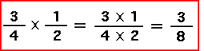
3/4 x 12/1

3 x 12 divided by 4  x 1 = 36/4 = 9

Can we make a general rule when multiplying fractions?
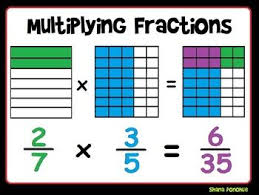
Multiply the numerators to get the top part of the fraction then multiply the denominators to get the bottom part of the fraction

Learners who immediately simplify 36/4 as 9 explain to their neighbour as to why they simplified the fraction

Find a Google image that reinforces your knowledge of multiplying fractions and explain
your learning to your neighbour.

Image result for multiplying fractions
Teacher provocation
Reread your general rule for multiplying fractions.
Multiply the numerators to get the top part of the fraction then multiply the denominators to get the bottom part of the fraction
Using this knowledge, can we say that when dividing fractions we divide the numerators to get the top part of the fraction and divide the denominators to get the bottom part of the fraction?
Learners guess either yes or no and are given time to explore online for the rules when dividing
fractions before an example is discussed
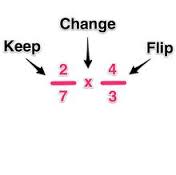
When dividing fractions, we go to KFC Keep, Flip, Change
KEEP first fraction
FLIP the fraction to the right of the division sign
CHANGE division to multiplication
Then use your rule “Multiply the numerators to get the top part of the fraction then multiply the denominators to get the bottom part of the fraction”
Example
2/7  ÷   3/4 becomes
Image result for dividing fractions
Answer 2 x 4      =  8
            7 x 3         21

An additional challenge was done using 3 fractions to reinforce the learning that we Keep the first fraction, Flip the fractions to the right of the division sign and then Change division to multiplication
Contextual challenge (card resource)
Mrs Dunn is creating a cut-out resource made from special paper. She has ⅔ of a page left and needs ⅙ of a page for each resource. How many cut-out resources can she make?

⅔   ÷  ⅙

⅔  x 6

12/3

4 cut-outs
Lesson sequence
Solving fraction x whole number

Solving fraction x fraction

Creating a rule when multiplying fractions

Exploring division of fractions

Division in context

Making learning visible and documenting evidence of learners’ understanding of multiplication and division of fractions by creating personalised notes, inserting images and explaining them to peers
Learning Experiences
Relating fractions to decimals

Exploring equivalent fractions

Developing and using strategies for multiplication and division of fractions
Resources
Google document
Teacher’s Google Number  site
Sharing learning
Teacher comments on personalised learners docs and their blogs
Learners blog their learning experience and comment on peers blogs
Next steps
Curriculum

Fraction, Decimal, Percent conversion
Daily life

Maximising discounts advertised as fraction and/or
percent
Reflection
Remembering KFC (Keep, Flip, Change) when dividing fractions evoked
much enthusiasm and discussion amongst learners


Number
Decimals


Year 9
Teacher practice
Constructivist
Experiential
Collaboration
Teacher conferenced with various groups using learners knowledge as a guide and answered all questions by probing and encouraging learners to communicate their thinking collaboratively so
that they could do critical thinking and show creativity as they learned (4 C’s for today’s Learners)
Learning Outcomes
Level 3: Ordering decimals
Level 4: Decimals and place value to 3 places
Level 5: Recurring decimals (extension)
Success criteria:
Learners are successful if they can order decimals, read decimals correctly, compare decimals
and write decimals as percentages

SOLO Taxonomy
Pre structural
Uni
structural
Multi
structural
Relational
Extended abstract
I need help
I can Identify Decimals
in daily life
I can describe a procedure and do calculations with Number problems in context
I can explain and organise my thinking to solve Number problems in context
I can create and predict solutions and reflect on my answers
Do Now (Introduction)
Rearrange these letters “a decimal point” to explain what a decimal is. Use each letter only once and use all letters.

Teacher reads the instruction aloud and answers any questions posed by learners

Learners work independently and/or collaboratively as they work towards a possible solution
I’m a dot in place
Lesson sequence
Rearrange given letters to better understand what a decimal point is

If I gave you $500 would you be happy?
Now along comes the decimal point and lands just after the number 5 to make $5.00, would you still be happy? Class discussion about the impact of the decimal point on the value of the money

Answer question 1 and 2 to determine learners’ curriculum level
Question 1. Four friends, Mele, Tui, Tevita and Anna can jump 3.1m, 3.15, 3.01 and 3.10m respectively. Arrange these distances in ascending order

Teacher comment: When rearranging or comparing, decimals, look at the first digit, of each number: if they are similar, then look at and compare the next digit eg in 3.15 and 3.01 (1/10 is greater than 0/10 or 15/100 is greater than 1/100), so 3.15 is greater than 3.01

Thinking/discussion: When comparing 3.1 and 3.10 both can be read as having 1/10, so the two decimals are equal.

Any zero after the decimal point that is not followed by another number is just a place-holder

Question 2. Draw a number line (any length) from 0 to 1. Mark the middle and give it a decimal value. Keep finding the middle until you reach 3 decimal places.

Use your learning outcomes table, from Mrs Dunn Maths site to determine the curriculum level for each Question (this is for learners to identify their learning needs)

Teacher provocations
How would you read this decimal 1.25?
one and twenty- five hundredths
one and two tenths and five hundredths
one point two five not one point twenty five - Learners work independently and/or collaboratively

Discuss how to read and compare decimals
Explore learning using online resources
Make learning visible by creating personalised notes documenting evidence of learners’ understanding of Decimals

Teacher provides opportunities for learners to develop and demonstrate their thinking by discussing with peers and documenting on a Google doc. Teacher expectation is that of learners’ managing their learning.
Learners self-manage by choosing the appropriate curriculum levels for the topic and can move on to the next level if they feel confident in their ability

Learners show evidence of their thinking and learning by creating personalised notes after navigating the hyperlinked Decimals resources on Mrs Dunn Maths site

All evidence of thinking/learning is visible on a Google document which is shared with the teacher and can also be shared with peers for commenting
Learning Experiences
Learners work independently and/or collaboratively. Writing decimals in words and symbols as learners often confuse decimals with money and read it incorrectly.

Learners work independently and/or collaboratively. Comparing decimals on number lines to see progressions from smallest to biggest

Learners work independently and/or collaboratively. Understanding decimals as percentages eg 0.25 is 25%
Resources
Smartboard or cut-outs of letters (so that learners can drag or rearrange letters)
Google document
Teacher’s Google Number  site
Literacy strategy
Word definition: Learners define unfamiliar terms
Word
My definition
Online definition
ascending
going up
go up or climb
Sharing learning
Teacher comments on personalised learners docs and their blogs
Learners blog their learning experience and comment on peers blogs
Next steps
Curriculum
Convert common Decimals up to 2 dp) to Fractions (L3) which will lead on to basic operations with fractions (L4,5 )
Daily life
Fractions are used in baking or cooking. Basic operations are used eg if ¼ cup of sugar, sometimes it is necessary to either double or halve the recipe.
Reflection
More emphasis needs to be placed on place value, particularly for numbers after the decimal point so that learners use words like tenths, hundredths and thousandths confidently. Using money as an example when learning about decimals is contradictory as $5.70 (five dollars seventy) is not read as five point seven zero dollars. There are no tens, hundreds and thousands after the decimal point; instead it is tenths, hundredths and thousandths


Number
Fraction, Decimal, Percent Conversion

Year 9
Teacher practice
Constructivist
Experiential
Differentiation
Teacher conferenced with various groups using learner knowledge as a guide and answered all questions by probing and encouraging learners to communicate their thinking collaboratively so that they can do critical thinking and show creativity as they learn (4 C’s for today’s learners)
Learning Outcomes
Level 3: Know fractions and percentages in everyday use
Level 4: Know the equivalent decimal and percentage forms for everyday fractions.
Level 5: Know commonly used fraction, decimal, and percentage conversions
Success criteria
Learners are successful if they can convert commonly used Fraction, Decimal and Percent and can work out prices regardless of whether discounts are expressed as Fractions or Percentages

SOLO Taxonomy
Pre structural
Uni
structural
Multi
structural
Relational
Extended abstract
I need help
I can Identify
Fractions, Decimals and Percent
I can describe a procedure and do calculations with Number problems in context
I can explain and organise my thinking to solve Number problems in context
I can create and predict solutions and reflect on my answers
Do Now (Introduction)
On weekends or after school, where do you see Fractions and/or Percent? Online activity
A few volunteers explain what they wrote on the lino board while the rest of the class listens attentively and respectfully
Lesson sequence
Question 1. Retailers express some of their discounts as Fractions and others as a Percent. Explain how to determine which discount will benefit you the most?
Briscoes is offering a 25% discount on a  $20 fan and The Warehouse is one third discount on a $30 fan.
Which retailer is offering you a better buy and how much change will you get if you pay with a $50 note.

Statement
Working
Answer
Briscoes discount
25% x $20
$5
Cost at Briscoes
$20 - $5
$15
Change at Briscoes
$50 - $15
$35
Warehouse discount
⅓ x $30
$10
Cost at Warehouse
$30 - $10
$20
Change (Warehouse)
$50 - $20
$30
⅓ is bigger than 25% (¼) so Better deal is at The Warehouse

Activity 1
*Screenshot a house on the internet that you would like to buy.
a) How much is the house?
b) Write this amount in words. (Level 3)
c) What will the deposit be? (Level 4)
d) How much will still be owing? (Level 3)
Real estate commission in Auckland ranges from 2.95 - 4% for the first $300 000 and then 2 - 2.5% thereafter. A base fee up to $500 is charged regardless of whether the house is sold or not. GST is also added.
e)How much commission would be made if you sold your house at the price mentioned in (a) (level 5)
Learning Experiences
Learners work independently and/or collaboratively by adding their contribution to the lino activity about where they see Fractions and/or Percent.

Learners work independently and/or collaboratively comparing fraction and percent

Learners work independently and/or collaboratively understanding and solving discount, deposit and commission questions

Talking about percentages in everyday contexts

Maximising discounts expressed as Fractions and/or Percent

Converting Fraction, Decimal, Percent

Encouraging creativity as learners explore and select an image of a house online

Using a calculator with confidence
Resources
Lino
Flyers
Junkmail
Online retail sites
Google document
Mrs Dunn maths Google site - Fraction, Decimal, Percent
Literacy strategy
Chunking - break information up into smaller pieces or chunks to facilitate understanding

Word definition
Word
My definition
Online definition
discount
less
deduction from the usual cost of something
percent
100
one part in every hundred
commission
don’t know
money paid upon completion of a task
retailer
not sure
business or person who sells goods to consumers
deposit
money that you put down
first instalment with the balance being paid later
Sharing learning
Teacher comments on personalised learners docs and their blogs
Learners blog their learning experience and comment on peers blogs
Next steps
Curriculum

Integers
Daily life

Daily temperatures
Credit and debt
Sea level (height above and below)
Reflection
Much enthusiasm was generated as learners compared their selected home with peers and some even ventured to homes in other countries - this will lead to exchange rates and ratio at a later stage


Number
Integers
Year 9
Teacher practice
Constructivist
Experiential
Differentiation
Teacher conferenced with various groups using student knowledge as a guide and answered all questions by probing and encouraging learners to communicate their thinking collaboratively so that they can do critical thinking and show creativity as they learn (4 C’s for today’s learners)
Learning Outcomes
Level 4: Understand addition and subtraction of integers.
Know the relative size and place value structure of positive and negative
numbers

Level 5: Understand operations on integers
Success criteria
Learners are successful if they can understand the size and place value of integers and can understand operations on integers

SOLO Taxonomy
Pre structural
Uni
structural
Multi
structural
Relational
Extended abstract
I need help
I can Identify
I can describe a procedure and do calculations with Integer problems in context
I can explain and organise my thinking to solve Integer problems in context
I can create and predict solutions and reflect on my answers
Do Now (Introduction)
Google today’s temperature in Auckland.  
240C

Choose a country or city in the Northern hemisphere and write down their temperature. Use Google maps if you need help finding a city or country.
Russia, -20C. Discussion about why other countries are not as warm as Auckland.

How much warmer is it in Auckland?
Discussion about writing learners’ answers using mathematical statements like  240C - -20C

Find at least 1 other Google image to help you understand when we use integers and then explain what an integer is in your own words.
Lesson sequence
Write a mathematical equation for each of the following.
Sela has $7 and finds $4 in her bag. How much does she have altogether?

Tere has 7 lollies and gives 4 away. How many lollies does she have left?

Tui is standing on a strip of blue tape. He takes 4 steps back and 7 steps forward. How many steps is he away from the tape?

Maia is standing in a lift at an entrance to a mine. The lift stops 7m below ground level  to drop off supplies and then makes a final stop 4 m further. At what depth did the lift make its final stop?

                 
7 + 4 = 11               7 - 4 = 3                  -4 + 7 = 3             -7 - 4 = -11

Integers in daily life

Explore learning using online resources

Make learning visible by creating personalised notes documenting evidence of learners’ understanding of Integers
Learning Experiences
Developing a number sense by exploring number in the context of everyday experiences and the world around them.

Using numbers to explore events in their own lives.

Developing mental strategies for adding, subtracting, multiplying, and dividing positive and negative numbers, using a calculator, a variety of models, and other approaches

Solving problems involving positive and negative numbers
Resources
Google images
Google maps
Google document
Teacher’s Google Number  site
Sharing learning
Teacher comments on personalised learners docs and their blogs
Learners blog their learning experience and comment on peers blogs
Next steps
Curriculum
Solving number problems in context
Daily life
Understanding and interpreting everyday number contexts
Reflection
The use of images hooked learners into understanding what integers are and the use thereof; particularly the use of integers in daily life


Number
Number in context
Year 9
Teacher practice
Constructivist
Collaboration
Teacher conferenced with various groups using student knowledge as a guide and answered all questions by probing and encouraging learners to communicate their thinking collaboratively so that they can do critical thinking and show creativity as they learn (4 C’s for today’s learners)
Learning Outcomes
Level 3: Describe a procedure and do calculations with Number problems in context
Level 4: Explain and organise thinking to solve Number problems in context
Level 5: Create and predict solutions and reflect on answers
Success criteria
Learners are successful if they can solve number problems in context

SOLO Taxonomy
Pre structural
Uni
structural
Multi
structural
Relational
Extended abstract
I need help
I can Identify
I can describe a procedure and do calculations with Number problems in context
I can explain and organise my thinking to solve Number problems in context
I can create and predict solutions and reflect on my answers
Do Now (Introduction)
Review images, notes, explanations, examples and challenges on your Number doc
Lesson sequence
Review learning on the Number topic to date
Attempt and solve a contextual task to give learners an indication of their achievement
Trip to Wellington

24 students in 9KLe were planning a trip to Wellington in September with the lovely Mr Mansell. The cost of the trip was $80 per student. The group had a sausage sizzle to raise funds. They needed 8 loaves of bread. Elstree Dairy had bread for $2.20 each, but the owner gave them a 15% discount. Students also bought $50 worth of sausages. Onions and tomato sauce were donated by the Geek Cafe. Students sold 110 sausages for $1.50 each and then had a bake sale a few days later. All baked goods were donated and students made a profit of $250. Mrs Dunn offered to donate ⅕ of the amount raised at the bake sale.  How much would each student have to pay?


Statement
Working
Answer (units)
Total cost of trip
$80 x 24
$1 920
Bread
8 x $2.20
$17.60
Bread discount
15/100 x $17.60
$2.64
Bread cost
$17.60 - $2.64
$14.96 rounded $15
Bread + sausage cost
$15 + $50
$65
Sausage sizzle
$1.50 x 110
$165
Sausage sizzle profit
$165 - $65
$100
Donation
⅕ x $250
$50
Bake sale + s sizzle + donation
$250 + $100 + $50
$400
Total owing
$1920 - $400
$1 520
Payment per student
$1 520 / 24
$63.33 rounded $63.30
shortfall
$1 520 - ($63.30 x 24)
$0.40, so someone will have to pay an extra 40c

Learning Experiences
Apply Number knowledge in real life contexts
Collaborate by discussing ideas and possible solutions
Resources
Google document
Teacher’s Google Number  site
Literacy strategy
Chunking
Sharing learning
Teacher comments on learners blogs
Learners blog their experience and comments on peers blogs
Reflection
Learners completed a survey (Google Form)
Something Old (what learners already knew)
Something New (any new learning or strategies gained during the Number strand)
Something Borrowed (an aspect of Number that learners taught their peers or vice versa)
Something Blue (an aspect of the Number strand that learners still do not fully understand)