Thursday, 16 November 2017

Summary of Raising Maori Achievement in Maths


Quick Read of my year-long Inquiry about Raising Maori achievement in maths by making teaching, learning and feedback visible and by discussing data with learners
71883692-084e-4b37-992a-8168a3663358.png
Making teaching, learning and feedback visible and sharing NCEA L1 data with learners to inform my teaching practice so that there is a shift in academic achievement of Maori Learners
spyglass_on_why.jpg
50% of our Maori Learners achieved L1 Numeracy the previous year compared to our national decile equivalent of 68.7%. 2017 school target is 80%.
Who.jpg
NCEA L1 Maori learners in 1104MAT
howdoI.jpg
VTaL framework          Google calendar       Sharing data with learners       Goal setting        Literacy Strategies

Teaching and learning strategies        Achievement objectives in “student speak”         Positive conversations

Appreciation postcards                Communicating with whanau about how WE can best support the learner TOGETHER
aha-1031.jpg
Communication with whanau about how best we could both support the learner for success.
Both teacher and whanau had great faith in their ability to achieve.
Learner efficacy improved as the quality and quantity of work met the requirements for NCEA L1
Constant reinforcement of teacher belief in learner ability
studentvoice_newlogo.png
"Every time you called my mum whether it was something good or bad it motivated me to do better in maths. The calls my mum received also helped me work harder to ask the teacher for help instead of acting like i know what im doing"

Teacher
Whanau
Learner
-talk less and give us more time to do our work
-let me listen to music
-Shes so positive and supports us better then most teachers.
-keeping the wifi on at night so I can do late night studies
-offer more support
-do work
-focus more
-sit in the front of the class
Image result for analysis
The end is now upon us and so I face the final analysis comparing 2016 NCEA L1 Maori data with that of 2017.

Credits
2016
2017
0 credits (Maori)
33%
0%
1 std away from Numeracy (Maori)
50%
0%
Numeracy (Maori)
17%
100%
Numeracy (Whole class)
26%
39%
Numeracy cross curricula (Whole class)
38%
47%

My takeaway (using data of learners who completed the school year):
Maori learners exceeded the college’s target of 80% getting numeracy

There was a 13% increase in numeracy for the whole class (from 26% in 2016 to 39% in 2017) and for Maori learners, there was an 83% increase in numeracy (17% in 2016 to 100% in 2017)

What did we do differently?
Teaching and learning was more visible using ViTaL sheets and Google calendars and feedback was based on effort using NCEA achievement criteria

The use of standard-specific literacy strategies were more explicit and deliberate:
Chunking
Word definition
3 level guide
Mnemonics
Donut
Give one, Get one

Academic achievement data conversation (both across all curriculum levels and for mathematics, for the year level, were shared and discussed at regular intervals)


What happened for the learners
Each learner had access to a teaching and learning Template for each Achievement Standard

Algebra - Internal  3 credits - Numeracy
ACHIEVED
Form equations, Solve equations (line graph), Substitute
MERIT
Interpret data (in context)
EXCELLENCE
Create and solve your own equation
Literacy Strategy:
Chunking
3 Level Guide
Achieved - Read on the line
Merit - Read between the lines
Excellence - Read beyond the lines
Teaching Strategy
Forming equations: Look for secret words: each, every, single, one, per; that number gets the letter

Solving equations: =sum(

Interpreting tables: Colour code cheapest prices and explain in context
The Key Competency “managing self” encouraged learners to
work at their own pace
choose their desired achievement level for each std
complete their learning programme by tracking their progress on a ViTaL sheet before sitting summative tasks

Conferencing was done at the learner’s request and feedback encouraged learning conversations about how to progress to the next level
Questions were answered with questions to promote independent thinking and proactive learners
What evidence do I have for this

Credits
2016
2017

0 credits (Maori)
33%
0%

1 std away from Numeracy (Maori)
50%
0%

Numeracy (Maori)
17%
100%
official
Numeracy (Whole class)
26%
39%
unofficial
Numeracy cross curricula (Whole class)
38%
47%
unofficial
What did I do to make this happen?
Teaching and learning was more visible using ViTaL sheets, Google sites and Google calendars

Achievement criteria and Teaching/Learning Strategies were explained in “student speak”


The use of standard-specific literacy strategies were more explicit and deliberate and understood and used by learners:
Chunking
Word definition
3 level guide
Mnemonics
Donut
Give one, Get one
Academic achievement data conversation (both across all curriculum levels and for mathematics, for the year level, were shared and discussed at regular intervals)
Wonderings about what next
Students - Can students continue to self-manage next year with a different teacher?
Teacher - Strategies to engage more Maori whanau so that we can best support the learner together

Monday, 13 November 2017

Manaiakalani CoL Inquiry Panel


What happened for the learners
Each learner had access to a teaching and learning Template for each Achievement Standard

Algebra - Internal  3 credits - Numeracy
ACHIEVED
Form equations, Solve equations (line graph), Substitute
MERIT
Interpret data (in context)
EXCELLENCE
Create and solve your own equation
Literacy Strategy:
Chunking
3 Level Guide
Achieved - Read on the line
Merit - Read between the lines
Excellence - Read beyond the lines
Teaching Strategy
Forming equations: Look for secret words: each, every, single, one, per; that number gets the letter

Solving equations: =sum(

Interpreting tables: Colour code cheapest prices and explain in context

The Key Competency “managing self” encouraged learners to
work at their own pace
choose their desired achievement level for each std
complete their learning programme by tracking their progress on a ViTaL sheet before sitting summative tasks

Conferencing was done at the learner’s request
Questions were answered with questions to promote independent thinking and proactive learners
What evidence do I have for this

Credits
2016
2017

0 credits (Maori)
33%
0%

1 std away from Numeracy (Maori)
50%
0%

Numeracy (Maori)
17%
100%
official
Numeracy (Whole class)
26%
39%
unofficial
Numeracy cross curricula (Whole class)
38%
47%
unofficial
What did I do to make this happen?
Teaching and learning was more visible using ViTaL sheets, Google sites and Google calendars

Achievement criteria and Teaching/Learning Strategies were explained in “student speak”


The use of standard-specific literacy strategies were more explicit and deliberate and understood and used by learners:
Chunking
Word definition
3 level guide
Mnemonics
Donut
Give one, Get one
Academic achievement data conversation (both across all curriculum levels and for mathematics, for the year level, were shared and discussed at regular intervals)
Wonderings about what next
Students - Can students continue to self manage next year with a different teacher?
Teacher - Strategies to engage more Maori whanau so that we can best support the learner together

Monday, 6 November 2017

The end is now upon us and so I face the final analysis

The end is now upon us and so I face the final analysis comparing 2016 NCEA L1 Maori data with that of 2017.


Credits
2016
2017
0 credits (Maori)
33%
0%
1 std away from Numeracy (Maori)
50%
0%
Numeracy (Maori)
17%
100%
Numeracy (Whole class)
26%
39%
Numeracy cross curricula (Whole class)
38%
47%


My takeaway (using data of learners who completed the school year) :
Maori learners exceeded the college’s target of 80% getting numeracy


There was a 13% increase in numeracy for the whole class (from 26% in 2016 to 39% in 2017) and for Maori learners, there was an 83% increase in numeracy (17% in 2016 to 100% in 2017)


What did we do differently?
Teaching and learning was more visible using ViTaL sheets and Google calendars


The use of standard-specific literacy strategies were more explicit and deliberate:
Chunking
Word definition
3 level guide
Mnemonics
Donut
Give one, Get one

Academic achievement data (both across all curriculum levels and for mathematics, for the year level, were shared and discussed at regular intervals)

Thursday, 19 October 2017

Literacy in maths

To sell the importance of literacy in maths, my students and I took a mock trip to China.

Once we landed in China, we discussed taking a shuttle or taxi to our hotel and realised that none of us could speak or read Chinese. This led to a healthy discussion about the importance of knowing the language, so getting learners to define terms like:
Transformations
Complementary angles
Supplementary angles
Invariant points
Types of angles
Polygons
Bearings, to name a few, had learners attempting to understand the language of Geometry with renewed vigour. To reinforce learning, learners explained the meaning of Geometry words and then copied and pasted an appropriate image. Their final challenge was to explain at least one of the words to their neighbour and vice versa.

Monday, 16 October 2017

DREAM BIG and ACHIEVE BIGGER


Image result for 23 Day 1 of term 4 and we have 23 Days to go (including weekends and Labour Day) before NCEA exams commence, nationwide. My 11's have set themselves a goal to gain UE numeracy between now and then. We all need to DREAM BIG and ACHIEVE BIGGER, so once we have UE Numeracy, we need to aim for credits in an additional standard.

Tuesday, 26 September 2017

Straight line

Image result for y = mx+c
Our Junior students are learning about straight equations so after using a few online interactive resources,  playing kahoot and completing a teacher-created Quizizz resource a few were still struggling to identify the gradient, also known as the slope or m value and the Y intercept or c value.

I had a conference lesson with 3 students and tried to break it down
s........l.....o.....w..........l.......y. using this example

y = 2x - 3
Teacher: Read this straight line equation
Student: y equals 2x minus 3

Teacher: Repeat it to your friend
Student: y equals 2x minus 3

Teacher: So to find the gradient you must look to see what is in front of the letter x. So what do you see in front of the letter x
Student: (silent)

Teacher: Remember to look  to see what is in front of the letter x
Student: Which way is the front?

This was a teachable moment .........................


Thursday, 14 September 2017

On the flip side

I am now left with 2 Maori learners in my maths class and one has exceeded achievement expectations: Read my post titled, "Nothing can burst my bubble" where the learner had a history of poor achievement and now 8 weeks later, has University Entrance numeracy.

On the flip side, I have a learner whose historical data was more impressive:
Maths - stanine 5 (year 9), stanine 7 (year 10)
Reading - stanine 6 (year 9), stanine 5 (year 10).

Both learners followed similar programmes and were exposed to similar teaching and learning strategies, resources and feedback. The only difference was whanau engagement as all attempts to connect with whanau regarding support have FAILED: no response to messages left or to texts sent and failure to attend student achievement conferences. An important piece of the puzzle is missing.

Wednesday, 13 September 2017

Nothing can burst my bubble


Historical data and evidence showed that one of my year 11 Maori learners was achieving below the norm in years 9 and 10:

Maths - Stanine 3 (year 9), ABSENT (year 10)
Creative Writing - 2P (year 9), 2A (year 10)

After 2 terms of trying a variety of
teaching and learning strategies
personalised learning
differentiated teaching
rewriting achievement objectives in "student speak"
goal setting activities and
student voice surveys, there was minimal shift in attitude and effort. and the learner still had incomplete work and had not sat any assessments.

I logged 4 incidences of disengagement and/or lack of equipment in maths and 2 incidences of reaching out to whanau for support.

Since whanau came on board (2 June), all entries have been about positive attitude and credit achievement.

What did we do differently to break the cycle of underperforming?

-Teacher and whanau made a commitment to each other to actively support the learner and relayed our commitment to the learner.

- Learner managed his Learning by using our Visible Teaching and Learning "Class Task Sheets" 

- Teacher minimised written feedback which encouraged the learner to engage in learning conversations

- Learner sat assessments when he felt that he had the confidence to be successful (as opposed to sitting assessments according to the year planner or when his peers were ready).

He was on 0 credits eight weeks ago and has since sat 3 assessments and been successful. In his recent assessment, he gained his first MERIT grade and now has a total of 10 credits in maths which means that he has University Entrance (UE) Numeracy. I contacted mum and left a message and mailed a RISE postcard home. Nothing can burst my bubble......................


Thursday, 7 September 2017

Gradient intro


Today our learners were building their knowledge bank about straight lines, in particular, X and Y axes and gradient.

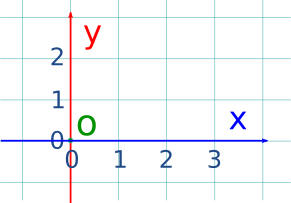
Remember "Y to the sky" (meaning that the Y axis goes straight up). The X axis runs across and the letter "x" looks like a cross,

Image result for Y axis

so after discussing X and Y axis the first point of discussion was:
Define gradient. Learners looked up the meaning on Google and there was a general consensus that SLOPE was the best definition and easiest to remember.

I wrote the word slope like this slope
and learners had to discuss the way the word was written.
the letter 'l"  was extra long indicating moving up or down and the Y axis first and the letter "e" represented the X axis running across, so gradient means move along the Y axis first, then the X axis.

Image result for define slope in maths
the gradient of this line is 3/5